How To Get Your Local Business Found on Google With Jess Freeman
Jun 04, 2026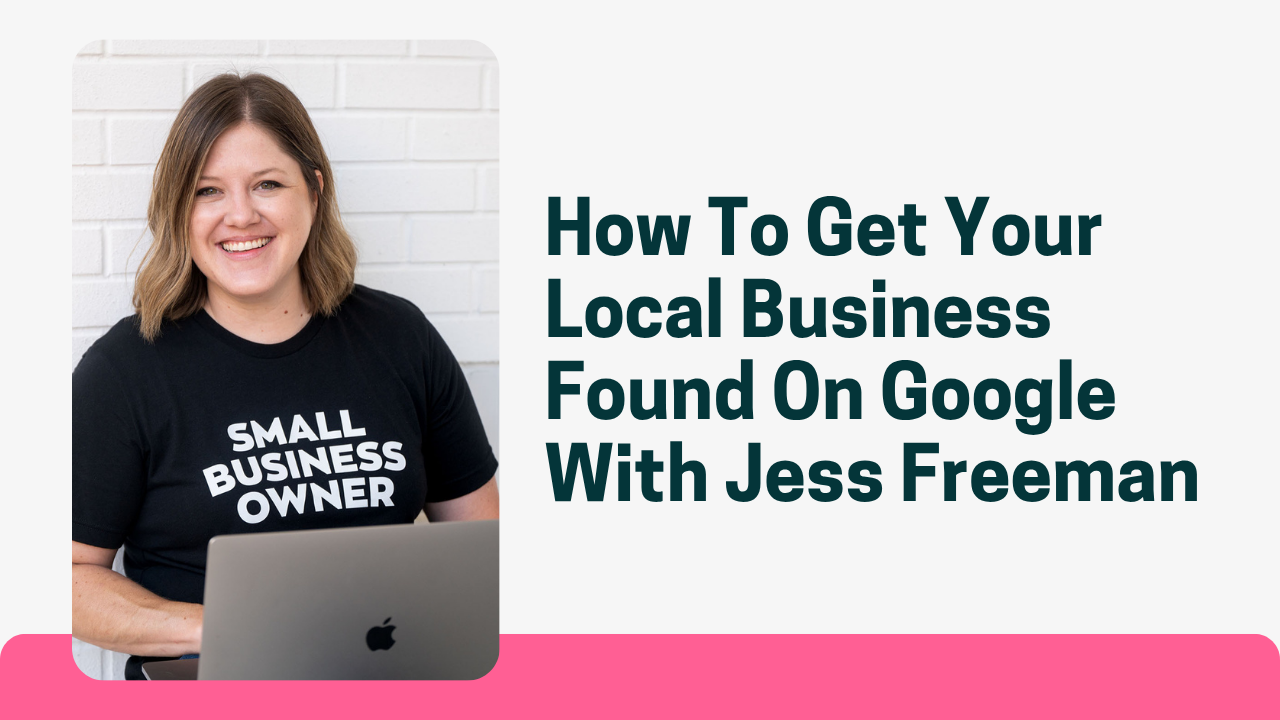
How to Get Your Small Business Found on Google (Without Losing Your Mind)
If you've ever wondered whether anyone is actually finding you on Google — or whether all your website effort is basically shouting into the void — this one's for you.
I sat down with Jess Freeman, web designer and SEO strategist behind Jess Creatives, to get real about what SEO actually means for small and local service businesses. Jess has been in this game for 15 years, and she has a refreshingly no-nonsense take on what matters, what doesn't, and where most business owners are wasting their time.
Start Here: Be Brutally Clear About What You Do and Where
If you serve a specific geographic area — whether you have a physical location or you just work with clients in a particular region — the two things Jess says matter most are clarity and location.
Your website needs to state plainly what you do. Not "I help you feel better." Not "I create transformative experiences." Think: physiotherapist, tax accountant, professional organizer. The specific words people actually type into a search bar.
And then pair that with location. Even if you work from home, even if you don't have an office, Google needs to know where you serve. "I serve the metro Atlanta area" or "serving southwest Ontario including Norfolk County and Cambridge" — that level of specificity helps Google understand who to show you to, helps potential clients quickly figure out if you're even relevant to them, and increasingly, helps AI tools like ChatGPT surface you when someone asks for recommendations in your area.
That clear language belongs up high on your website — in your header, ideally. Not buried in the footer.
Common SEO Mistakes (That Are Surprisingly Easy to Make)
Installing an SEO plugin and calling it done. If you're on WordPress, you may have heard that tools like Yoast or RankMath are the key to SEO. They can be helpful — but installing them is just the setup. It's like buying a gym membership and thinking you're fit. You still have to actually fill in the fields, and fill them in correctly.
Using "flowery" language where keywords need to go. Jess hears this constantly: clients who don't want their SEO title to say "Atlanta Dietitian" because it feels too plain. Here's the thing — SEO is data, not art. No one is searching "Atlanta Moment Maker." They are searching "Atlanta dietitian." You can be creative everywhere else on your site. Your SEO titles and focus keywords need to reflect what people are actually typing.
Writing the blog post first, then trying to make it SEO-friendly. This is one of the most common blogging mistakes Jess sees. You write a thousand-word post, then go looking for a keyword that fits — and discover that nobody is actually searching for what you wrote about. Now you either have a post that will get no traffic, or you're trying to awkwardly retrofit your content around a keyword that doesn't quite fit. The fix: do your keyword research first, then write.
Giant location keyword dumps. You know those websites that have a paragraph listing every single suburb in a 50-mile radius? That's not the move. It looks spammy and Google knows it.
Do You Actually Need a Blog?
Yes. Even if you're a local service business.
Jess uses a great analogy here: a three or four page website with no blog is basically a brochure. It gives people the basics. But Google — and the people using it — want more. A website with a library of helpful content is like showing up to a research question with an actual stack of books instead of a pamphlet.
Google's Helpful Content Update has made this even more important. They're actively prioritizing websites that demonstrate expertise and genuine usefulness. That means content that shows you actually work with real clients, that you know your stuff, that you have opinions and experience worth reading.
Which brings us to AI.
Can You Just Have ChatGPT Write Your Blog Posts?
Short answer: not if you want to rank.
Google is increasingly looking for evidence of real expertise and lived experience — phrases like "when I worked with a client" or "in my 12 years doing this." ChatGPT can't fake that convincingly, and even if you try to prompt it to, the result tends to be too generic to actually rank. This is especially true in health, fitness, and wellness spaces, where Google holds content to a higher standard.
AI is also a bad choice for generating your keywords. ChatGPT doesn't have access to actual search volume data — it can suggest words that sound reasonable but don't exist as real search terms, or that are so competitive you'd never rank for them. You can use AI to brainstorm keyword variations, but you need a real SEO tool to validate whether anyone is actually searching for them.
Free (and Low-Cost) Keyword Tools Worth Knowing
Jess recommends Ahrefs as her go-to. They have a free keyword generator tool — search "Ahrefs free keyword generator" to find it, because it's a bit buried. For those ready to invest a little, Ahrefs has a starter plan and Keysearch is another solid option in a similar price range. Prices shift, so check current rates before committing.
The key workflow: research first, write second.
Meta Descriptions, Image Alt Text, and Other Tedious-But-Worth-It Stuff
Meta descriptions are the two lines of text that appear under your page title in search results. They don't carry as much SEO weight as they used to — Google has gotten smarter about reading your actual content — but they matter for click-through rates. Write them for humans. Make them compelling enough that someone scrolling past a page of results thinks, that one. A keyword or two woven in naturally doesn't hurt, but the goal is to get the click.
Image alt text is the hidden description attached to images on your site. It serves two purposes: accessibility (screen readers use it) and a minor SEO signal. Before uploading an image, rename the file to something descriptive — not "IMG_4821.jpg" but something like "lindsay-canadian-copywriter.jpg." Then in the alt text field, write a natural description of what's in the photo and work in a keyword where it fits organically. Not a keyword dump. An actual description.
Neither of these is the highest priority item on your SEO list, but they're worth doing right when you're already in there.
Google Business Profile: Don't Sleep On It
If you serve local clients, your Google Business Profile matters — a lot. It influences whether you show up in the "map pack" (that cluster of three businesses with a map that appears at the top of local search results). The factors Google weighs include proximity, the number of reviews you have, and how recent those reviews are.
A few things Jess recommends:
Set up a system for collecting Google reviews. Most happy clients will do it — they just need a gentle nudge. Whether that's a text after an appointment, a sign at your front desk, or a follow-up email, make it easy and make it a habit.
Respond to every review. It doesn't have to be elaborate — a simple, warm thank-you is enough. Google interprets responses as a sign that you're an active, engaged business.
Check your profile periodically to make sure your business category and description are still accurate. Jess recently looked at hers and found it was still mentioning print design from a service she no longer offers. Easy fix, but worth catching.
And even if you're not locally based, a Google Business Profile is still worth having — it's attached to your brand name and contributes to your overall search visibility.
SEO vs. Social Media: Do You Have to Do Both?
This came up because so many business owners are feeling the fatigue of social media, especially Instagram. And Jess's take is genuinely reassuring.
SEO gives you the freedom to not feel so pressured by social media. She has a blog post from eight or nine years ago that still drives traffic and inquiries today. No reel from six weeks ago can say the same.
That said, SEO takes time. A brand new website might take a year to see real traction. You're not going to get the dopamine hit of 200 likes. It's a long game — but it's an evergreen one.
The sweet spot Jess has landed on: because her SEO is solid and doing its job, she can show up on social media because she wants to, not because she's terrified of what happens if she doesn't. That's a very different relationship with content creation.
"My Business Is Doing Fine. Do I Still Need to Worry About This?"
Maybe you're thinking about that local business in your town — the one where the owner is well-known, well-loved, and fully booked. Do they even need to bother with SEO?
Jess's answer: yes, and here's why. You don't know what's coming. Clients move. They recover and no longer need your services. Business slows. And if you've been coasting on referrals and community reputation, catching up when things slow down is much harder than maintaining a foundation while things are good.
Even referrals go to your website. Someone recommends you to a friend — but that friend is still going to look you up. What they find either confirms the referral or creates doubt. Your website is part of the close, even when you're not in the room.
And if you're not fully booked — even if you're pretty busy — a functioning SEO strategy means you can build a waitlist instead of scrambling to fill gaps.
Is SEO Ever Actually Done?
Yes and no.
If a page starts ranking for its target keyword — stop touching it. It's working.
For other pages still climbing, you may need to keep adjusting. But Jess advises against making SEO changes more than every 60 to 90 days. Google needs time to process and respond to your changes. Tweaking constantly means you'll never know what actually worked.
The mindset shift: SEO is something you can always be working on, but you don't always have to be. Keep an eye on it. Don't ignore it forever. But don't treat it like a weekly task either.
🎧 Listen to the podcast
If you're a local, service-based business owner who's done great work but struggling to put it into words, Market This is the podcast that helps you fix that.
Listen to the show here:
Spotify: https://open.spotify.com/show/1rfllDKDEW62DQBb7HMBHS
Apple Podcasts: https://podcasts.apple.com/us/podcast/market-this-local-business-marketing-content-marketing/id1719786195